
For decades, the words sewer line repair struck fear into homeowners for one reason: digging. When a sewer pipe malfunctioned, the only solution was to excavate large sections of a property, tear up the yard, remove landscaping, and spend thousands restoring everything afterwards. Today, however, that traditional approach is no longer the only option. With the development of trenchless sewer repair, homeowners can fix underground piping issues faster, cleaner, and far more affordably.
At the heart of this advancement is pipe relining, a method that restores an existing sewer line from the inside out without the need for major excavation. The result is a brand-new, structurally sound pipe installed within the old one – all with minimal disturbance to your property. As aging infrastructure continues to create challenges for homeowners, pipe relining has quickly become the preferred solution for damaged sewer lines.
This long-form guide explains how trenchless sewer repair works, why pipe relining is so effective, and what makes it a budget-friendly choice for homeowners who want long-lasting results without destroying their yard.
What Exactly Is Trenchless Sewer Repair?
Trenchless sewer repair is a modern method of fixing underground sewer lines without digging long trenches. Rather than excavating the entire length of a pipe, technicians use one or two small access points. Through these points, a flexible liner coated in epoxy is inserted into the old pipe. Once inflated and cured, the liner hardens to form a new pipe within the existing structure.
The result is a smooth, durable, seamless pipe that often outperforms the original material – yet the ground above it remains virtually untouched.
Homeowners, businesses, and municipalities choose this approach because it eliminates the most expensive and disruptive part of traditional sewer repair: excavation. For homes with landscaped yards, mature trees, paved driveways, or limited access, trenchless repair is not just convenient – it’s often the only practical solution.
How Pipe Relining Works: A Step-By-Step Overview
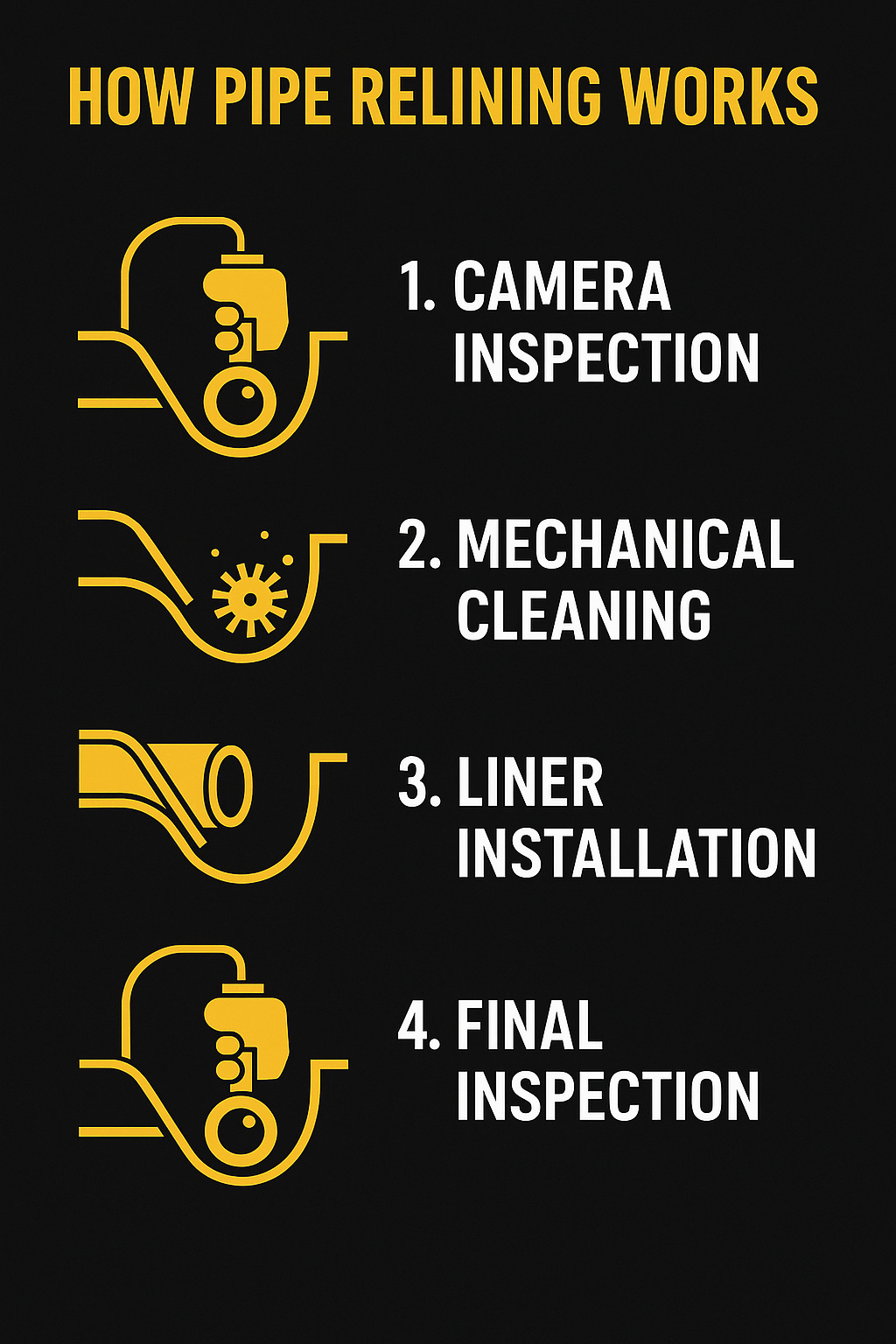
Pipe relining is highly technical, but the process is straightforward once broken down. It typically includes four main stages: inspection, cleaning, installation, and curing.
1. Camera Inspection
Before any repair begins, technicians insert a waterproof camera into the sewer line. This inspection reveals the condition of the existing pipe, the location of cracks or intrusions, and any structural weaknesses. It also confirms whether trenchless repair is viable.
Issues commonly identified include: corrosion, age-related wear, tree root penetration, misalignment, blockages, or small collapses.
2. Mechanical Cleaning
For the liner to adhere properly, the inside of the existing pipe must be thoroughly cleaned. Technicians use high-pressure water jets or mechanical cutting tools to remove debris, grease, deposits, or roots. A smooth internal surface ensures the epoxy bonds evenly and creates a structurally sound result.
3. Liner Installation
Technicians insert a flexible felt or fiberglass liner saturated with epoxy through an access point and position it along the damaged section. They then inflate the liner with air or steam, pressing it tightly against the interior walls of the old pipe. As the epoxy cures, it hardens into a new pipe that seals any previous cracks or openings.
4. Final Inspection
After the liner cures, technicians run another camera inspection to confirm that it has bonded uniformly, eliminated all damage, and restored smooth, proper flow. Once they approve the repair, the pipe is typically ready for use the same day.
This entire process often takes less than a single workday – a stark contrast to multi-day excavation projects that leave a property disrupted for weeks.
Why Trenchless Sewer Repair Is Superior to Traditional Dig-and-Replace Methods
For years, homeowners had only one option: dig up the pipe and replace it. While this may still be necessary in severe cases (such as a total pipe collapse), trenchless repair offers several advantages that traditional methods simply can’t match.
Minimal Damage to Your Property
Conventional sewer repair can require excavators, trenches several feet deep, and land clearing for everything above the pipe – gardens, grass, patios, decks, driveways, and even trees. Trenchless methods avoid all of this by needing only a small access point, leaving your yard intact.
For homeowners who have invested in landscaping or hardscaping, the ability to preserve those elements is a major benefit.
Reduced Project Costs
It’s a common misconception that trenchless repair is more expensive than traditional methods. While the per-foot cost of relining can be higher, the overall project cost is usually lower because it eliminates the most expensive part of sewer repair: property restoration.
Restoring sod, re-pouring concrete, or rebuilding a deck can cost thousands on top of the pipe replacement itself. With trenchless repair, those expenses disappear entirely.
Faster Completion Times
Traditional sewer replacement can take several days, especially if weather delays excavation. Trenchless repairs are typically completed within hours. This is because the process doesn’t involve digging, there are fewer variables that slow down the work.
This fast turnaround is especially valuable for families who rely on their plumbing system daily and can’t afford extended disruptions.
Long-Lasting Results
A relined sewer pipe isn’t simply patched – it becomes a brand-new, structurally sound pipe. The cured epoxy is resistant to corrosion, cracking, and tree root intrusion, and the seamless interior improves flow efficiency.
Many relined pipes come with warranties of 20–50 years, providing long-term security and peace of mind.
Signs That Your Home May Need Trenchless Sewer Repair
Homeowners often ignore early warning signs of sewer issues until major damage occurs. Sewer problems typically start small and recognizing symptoms early can save thousands in repairs.
Here are a few of the early warning signs:
- Slow drains throughout the home
- Frequent backups or gurgling noises
- Sewer odours indoors or outdoors
- Patches of soggy, sunken, or unusually green lawn
- Tree roots growing near sewer lines
- Water pooling in the basement or around floor drains
If you notice these signs, a camera inspection is the best first step. Many issues can be addressed quickly through relining before they become emergencies.
When Trenchless Repair Isn’t the Right Fit
Although trenchless sewer repair is effective in most situations, there are scenarios where it may not be possible. For example, if the pipe has fully collapsed and no open channel remains, a liner cannot be inserted. Severe misalignment, extensive missing sections, or improper slope may also require excavation or full pipe replacement.
However, these cases are the exception. In the vast majority of situations, trenchless pipe relining is a reliable, long-lasting solution.
How Pipe Relining Protects Your Yard – and Your Budget
The biggest advantage of pipe relining is that it avoids the destructive nature of excavation. Everything above your sewer line stays intact – gardens, patios, walkways, lawn, and trees remain undisturbed. This alone can save thousands in restoration costs.
But homeowners also save money in other ways:
- Fewer labour hours
- Lower equipment costs
- No property reconstruction
- Reduced risk of future damage
Since the new pipe is seamless, tree roots – one of the most common causes of sewer failure – can no longer penetrate. This significantly reduces the chance of future repairs.
Combined, these benefits make trenchless repair one of the most cost-effective long-term investments a homeowner can make in their property.
Ready to Learn More or Get a Professional Assessment?
If you’re dealing with recurring sewer issues – or simply want peace of mind before a small problem becomes a major expense – trenchless sewer repair is one of the most reliable, long-term solutions available. A professional assessment can help you understand the condition of your sewer line, determine whether pipe relining is the right fit, and give you a clear, upfront estimate without guesswork or disruption to your property.
When you’re ready to take the next step, the M. Riddle team is here to help. You can speak with a professional, ask questions, or request a quote directly.